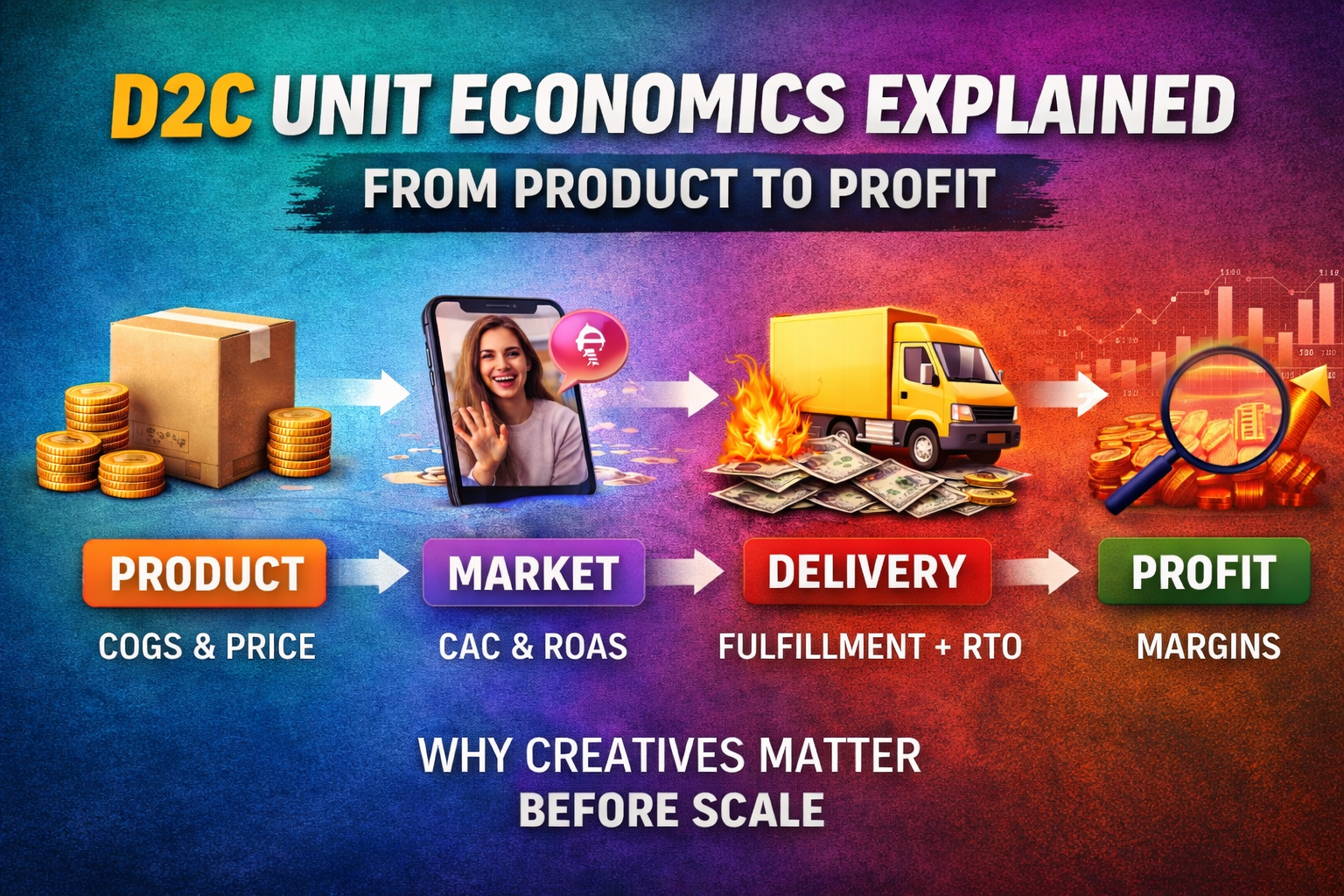
The Correct Product → Price → Market → Delivery Lifecycle
Most D2C brands jump straight to ads and ROAS.
But unit economics is decided much earlier — before a single rupee is spent on marketing.
A D2C business does not start with AOV.
It starts with product cost and selling price.
Let’s break this down in the exact order a D2C business actually works.
STAGE 1: PRODUCT CREATION (FOUNDATION)
1. Cost of Goods Sold (COGS)
This is the first non-negotiable number.
COGS includes:
- Manufacturing or sourcing
- Raw materials
- Packaging
- Labeling
- Inbound logistics
Example:
If one unit costs ₹350 to make and pack:
COGS = ₹350
If this number is wrong, nothing else will work — not pricing, not ads, not scale.
STAGE 2: SELLING PRICE (BEFORE ANY MARKETING)
2. Selling Price (MRP / Listed Price)
Before AOV, before CAC, before ROAS — you decide what price the product will be sold at.
Example:
Selling Price = ₹1,000
This price must eventually cover:
- Product cost
- Marketing cost
- Logistics
- Returns
- Overheads
- Profit
If your selling price only works with heavy discounts, your unit economics are already weak.
STAGE 3: GROSS MARGIN (FIRST GO / NO-GO CHECK)
3. Gross Margin
This is the first real validation checkpoint.
Formula:
Gross Margin = (Selling Price − COGS) ÷ Selling Price
Example:
Selling Price = ₹1,000
COGS = ₹350
Gross Margin = 65%
This margin is what funds:
- Ads
- Logistics
- Returns
- Team
- Growth
If gross margin is below ~60%, paid performance becomes risky.
STAGE 4: MARKET ENTRY (WHEN ADS START)
4. Customer Acquisition Cost (CAC)
Now marketing begins.
Formula:
CAC = Total Ad Spend ÷ Orders Generated
Example:
₹4,00,000 ad spend ÷ 800 orders = ₹500 CAC
CAC must fit inside your gross margin.
High CAC is not a marketing problem — it’s a unit economics problem.
This is where creative and messaging matter more than media buying.
If ads attract the wrong audience or set wrong expectations, CAC and returns both spike.
This is exactly the gap GetADict focuses on —
ensuring ads communicate the right message to the right buyer, at the right stage, so acquisition doesn’t break economics.
5. ROAS (DELIVERY EFFICIENCY, NOT PROFIT)
Formula:
ROAS = Revenue from Ads ÷ Ad Spend
Example:
₹8,00,000 ÷ ₹4,00,000 = 2.0 ROAS
Critical truth:
ROAS only tells you how efficiently ads deliver revenue.
It does not tell you whether the business is profitable.
Many D2C brands die with “good ROAS” because the creative sells clicks, not clarity.
STAGE 5: ORDER VALUE (AOV COMES HERE)
6. Average Order Value (AOV)
AOV is not decided upfront.
It is observed after orders start coming in.
Formula:
AOV = Total Revenue ÷ Total Orders
Example:
₹10,00,000 revenue ÷ 1,000 orders = ₹1,000 AOV
AOV improves when:
- Buyers understand value
- Expectations are aligned
- Upsells feel natural
This doesn’t happen through discounts — it happens through clear positioning and trust, which is why GetADict treats UGC and creatives as performance assets, not just content.
STAGE 6: FULFILMENT & PAYMENT COSTS
7. Fulfilment, Shipping & Payment Fees
Every order has operational costs:
- Forward shipping
- Packaging material
- Payment gateway fees
- COD handling charges
Example:
Fulfilment + fees = ₹100 per order
These costs scale directly with volume.
STAGE 7: RETURNS & RTO (CRITICAL IN INDIA)
8. RTO & Returns Impact
Often ignored. Always dangerous.
RTO and returns usually happen due to:
- Wrong audience acquisition
- Misleading creatives
- Over-promising in ads
- Poor expectation setting
Every return eats:
- Shipping
- Packaging
- Time
- Cash flow
High RTO is not a logistics problem.
It is a messaging problem.
This is another area where GetADict’s full-funnel creative approach directly protects margins — by aligning what ads promise with what the product actually delivers.
STAGE 8: CONTRIBUTION MARGIN (FINAL TRUTH)
9. Contribution Margin (Per-Order Profitability)
Formula:
Contribution Margin =
Selling Price − (COGS + CAC + Fulfilment + Returns)
Example:
- Selling Price: ₹1,000
- COGS: ₹350
- CAC: ₹500
- Fulfilment: ₹100
Contribution Margin = ₹50
If this number is negative, scale only makes losses louder.
WHERE GETADICT FITS IN THIS ENTIRE SYSTEM
GetADict does not “run ads” in isolation.
We work before scale breaks your economics.
Our role is to:
- Fix product messaging before spend increases
- Turn UGC into funnel-specific performance assets
- Reduce CAC by attracting the right buyers
- Lower returns by setting correct expectations
- Protect contribution margin through clarity
Better creatives don’t just improve ROAS.
They protect the business.
FINAL THOUGHT
Before asking:
“Why are ads not scaling?”
Ask:
“Is my product, pricing, messaging, and funnel built to survive scale?”
Because growth doesn’t fix bad math.
It exposes it.
And the fastest way to break unit economics
is scaling confusion.
That’s exactly what GetADict exists to fix.