If your ads are getting impressions but not converting, most people blame the targeting. Or the offer. Or the landing page.
Very few look at hook rate.
That’s a mistake because hook rate is usually where the real problem starts.
This post explains what hook rate is, why it matters more than most metrics in your ad account, how to calculate it, what benchmarks actually mean, and what to do when yours is low.
What Is Hook Rate?
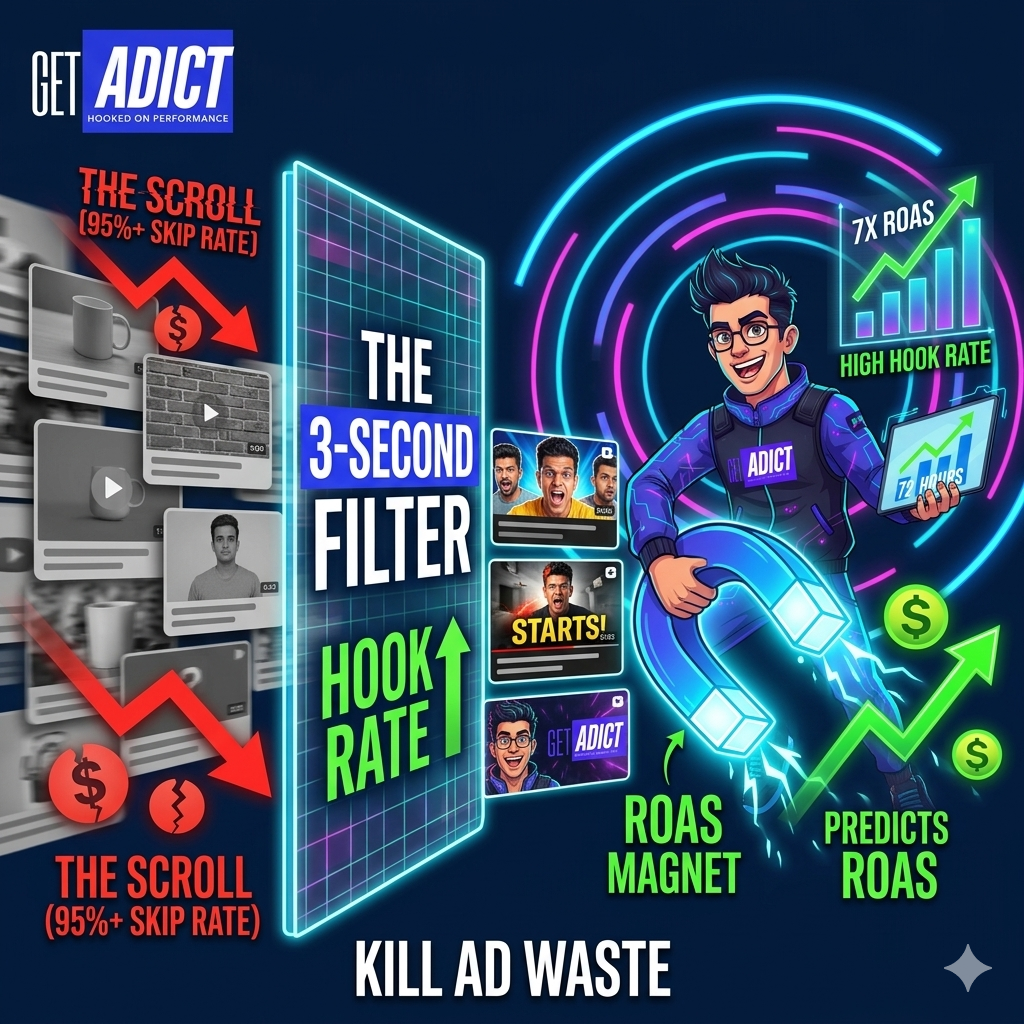
Hook rate is the percentage of people who continue watching your video ad beyond the first 2–3 seconds, out of everyone who was shown the ad.
The formula is straightforward:
Hook Rate = (3-Second Views ÷ Total Impressions) × 100
So if your ad received 10,000 impressions and 3,000 people watched past the 3-second mark, your hook rate is 30%.
It sounds simple. But what it tells you is far more important than most brands realise.
Why Hook Rate Is the First Metric You Should Check
Most performance marketers start with ROAS, CAC, or CTR when diagnosing a struggling ad. Hook rate is rarely the first place they look.
But here’s the problem with that approach: if your audience isn’t watching past 3 seconds, nothing else matters. Your offer doesn’t get seen. Your product benefit doesn’t register. Your CTA is never reached.
Low hook rate means you’re paying for impressions that deliver zero message. Every rupee spent on a low-hook-rate ad is money spent on a blank wall.
Hook rate is the gateway metric. If it fails, everything downstream fails with it.
What Hook Rate Actually Measures
Hook rate measures one thing: did your opening seconds earn the right to continue?
The first 2–3 seconds of a video ad do a very specific job. They need to interrupt a person who is already doing something else scrolling, watching, browsing and give them a reason to stop.
This is not about being flashy. It’s about being immediately relevant.
A high hook rate tells you that your opening spoke directly to the viewer’s situation, curiosity, or pain. A low hook rate tells you that the opening was either confusing, uninteresting, or looked like an ad which on most platforms today is enough reason for people to skip.
Hook Rate Benchmarks: What Are Good Numbers?
There’s no universal benchmark for hook rate because it varies by platform, placement, and audience. But here are practical reference points based on performance creative work:
- Below 20%: Weak hook. The opening is not earning attention. Most of your media budget is being spent on a message nobody is receiving.
- 20–30%: Average. The ad is working for a narrow segment of your audience. There’s room to improve and improving hook rate here typically has an immediate impact on ROAS.
- 30–40%: Strong. Your hook is working for a meaningful portion of your audience. This is the threshold where ads tend to have efficient learning velocity and scale more reliably.
- 40%+: Exceptional. This level of hook performance is rare and usually indicates a hook that speaks directly to a high-intent audience with a clear, relevant message.
These numbers are directional, not absolute. A 25% hook rate in a broad cold audience campaign can be excellent. A 25% hook rate in a warm retargeting campaign might indicate a problem. Context matters.
What matters most is comparing hook rate against your own historical performance, not an external number. If your hook rate drops from 32% to 19% over two weeks, that’s creative fatigue and that’s a signal you need to act on.
Hook Rate vs Other Metrics: How They Connect
Hook rate doesn’t exist in isolation. It’s the first domino in your creative performance chain.
- Hook rate → Retention rate: If people watch past 3 seconds, what percentage continue to the midpoint or the end? Hook rate gets them in; retention rate tells you if the rest of the ad keeps them.
- Hook rate → CTR: Low hook rate almost always means low CTR, because people who don’t watch don’t click. But high hook rate with low CTR tells you the message is engaging but the CTA or offer isn’t compelling enough.
- Hook rate → ROAS: This is the relationship most brands care about. Hook rate is a leading indicator of ROAS. If your hook rate starts dropping before ROAS does, you have a window to intervene before you feel the financial impact.
Think of hook rate as an early warning system. It tells you what’s going wrong before the revenue metrics show it.
Why Most Ads Have a Hook Rate Problem
The most common reason hook rate underperforms is also the most avoidable: the ad opens with the brand.
Brand logos, product shots, or name reveals in the first 2 seconds are the fastest way to kill hook rate. They signal to the viewer that this is an ad and the modern consumer’s response to that signal is to scroll.
Other common causes of low hook rate:
- Opening with a generic scene that doesn’t immediately communicate who the ad is for
- Starting with product features before establishing relevance
- Using slow, atmospheric builds that work for brand films but fail in paid environments
- Hooks that are too clever the audience doesn’t understand the relevance fast enough
- Hooks that work for warm audiences being tested on cold traffic
How to Improve Hook Rate: What Actually Works
Hook improvement is a testing discipline, not a creative instinct exercise. Here’s what consistently drives hook rate up:
1. Start with the problem, not the product
Your viewer does not care about your product in the first 3 seconds. They care about themselves. Open with something that immediately names their situation.
“Struggling to get ROAS above 2x even though your ads look great?” will outperform “Introducing [Brand Name]” nearly every time — because the first sentence earns attention from the right person.
2. Use pattern interrupts
On platforms like Instagram and Facebook, the feed is built for passive scrolling. Your hook needs to break that pattern. This can be a surprising visual, a bold statement, a question, or a specific and unexpected number.
What doesn’t work: anything that looks like it was professionally produced. What works: something that looks like it belongs in the feed but says something worth stopping for.
3. Test multiple hooks for the same narrative
The message in your ad might be strong. The hook might be the only weak link. A modular creative approach where you test 3–5 different openings on the same core narrative is one of the most efficient ways to improve hook rate without rebuilding the entire ad.
This is why a creative testing system matters more than individual ad creation. When you have a system, you learn which hooks work for which audiences and why.
4. Align the hook with funnel stage
A hook built for cold traffic (someone who doesn’t know your brand) needs to work very differently from a hook built for warm retargeting (someone who has visited your site or engaged before).
Cold traffic hooks need to establish relevance immediately. Warm audience hooks can be more direct. Misaligning these is a common reason hook rates disappoint even when the creative quality is high.
Hook Rate as a Creative Decision Signal
Beyond being a performance metric, hook rate is one of the most valuable creative decision tools available.
When you run multiple hooks for the same ad and compare hook rates, you’re not just finding the best performing ad. You’re learning which messages your audience responds to and that learning transfers to every creative decision you make after.
Brands that treat hook rate as a signal not just a number to optimize build creative systems that compound over time. They stop guessing and start making decisions based on what their audience actually responds to.
The Difference Between Attention and Intent
One important caveat on hook rate: high hook rate doesn’t guarantee conversions.
It’s possible to build a hook that stops the scroll for the wrong reasons it’s entertaining, surprising, or visually unusual but doesn’t attract buyers. In those cases, you’ll see high hook rate with low ROAS, which usually means the hook is drawing in a broad audience rather than a purchase-intent audience.
The goal is not the highest possible hook rate. The goal is the highest hook rate among people who are likely to buy. This is why hook rate is best read alongside conversion metrics, not in isolation.
Final Thought
Hook rate is the most honest early metric in performance marketing. It tells you whether your creative is earning attention before you’ve spent enough to see ROAS or CAC data.
Most brands check hook rate too late after ROAS has already dropped, after budgets have been wasted, after the algorithm has been trained on the wrong signals.
Check it first. Optimise it early. Build a system that keeps it healthy.
That’s how performance marketing becomes predictable.
Not sure why your ads are underperforming? Get a free creative audit from GetADict.
We look at your hook rate, funnel structure, and messaging — and tell you exactly what to fix. No pitch. Just clarity. Book your free audit →